Netradar at TM Forum’s Innovate Asia: A Catalyst Built on Collaboration

This week, Netradar had the privilege of joining TM Forum’s Innovate Asia, one of the region’s most influential gatherings for telecom innovation. The event brought together operators, vendors, and technology leaders shaping the future of digital networks.

Throughout the event, we met with 50+ customers and partners across APAC, holding deep discussions on network experience, AI-driven automation, and the future of customer-centric telecom operations. It was an inspiring platform to exchange ideas, explore new opportunities, and showcase the collective achievements of our ecosystem.
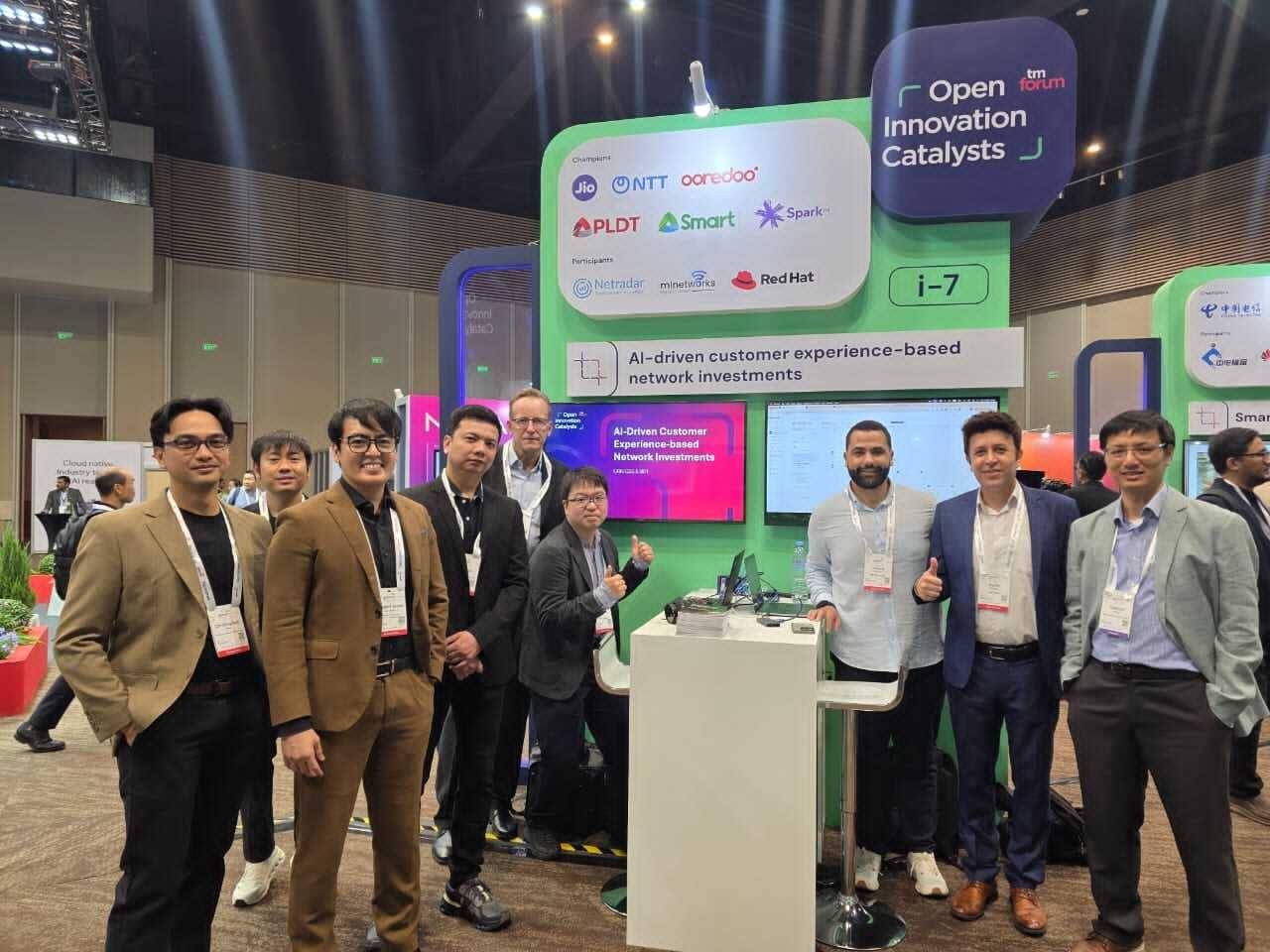
Proud to Be Finalists in Two Award Categories

We are delighted to share that our joint Catalyst project was selected as a finalist in not one, but two categories at Innovate Asia:
Business Gamechanger and Innovation with Purpose.

This recognition is a strong validation of the collaborative work we’ve done to help telecom operators rethink how they invest, optimize, and deliver customer experience more effectively.

About the Catalyst

Our Catalyst focused on solving one of the industry’s biggest challenges:
How can operators make smarter, real-time, customer-centric network investment decisions?

By combining AI-driven analytics, a decentralized Physical Infrastructure Network (DePIN) model, and continuous real user experience data, the solution transforms everyday smartphones into a global sensing network. Users are incentivized transparently through blockchain-backed rewards, while operators gain:

  • 24/7 hybrid-quality customer experience insights
  • AI-driven root-cause analysis for faster troubleshooting
  • Predictive congestion and targeted investment recommendations
  • 10–15% improvement in customer retention
  • Up to 10% reduction in CAPEX

This marks a significant shift from traditional engineering-led investment decisions toward experience-led, data-driven network optimization.

A Celebration of Partnership

While becoming finalists is something we’re truly proud of, the real success of this Catalyst lies
in the exceptional collaboration behind it.

From designing the concept to aligning the technical architecture and business outcomes, every partner brought unique expertise, energy, and a commitment to innovation. This joint effort shows what can be achieved when we combine strengths and work toward a shared purpose.

Looking Ahead

Innovate Asia reinforced an important message: the future of telecom lies in openness—open data, open collaboration, and open innovation across operators, vendors, and communities.

We’re proud of what we achieved together at Innovate Asia, and we’re excited for the next steps as we continue scaling this approach globally with our partners and customers.

Rising Star Award at DTW25: AI-Powered Revolution in Customer Experience

We’re thrilled to announce that our Catalyst project, “AI-Powered End-to-End Solution for Customer Experience,” has been honored with the prestigious Rising Star Award at DTW25! This recognition from TM Forum, awarded among 58 innovative projects, underscores the groundbreaking nature and significant impact of our work in transforming customer experience for Communication Service Providers (CSPs). Our project was even nominated as a Finalist in all three categories we applied for, highlighting its broad appeal and strong potential.

This success wouldn’t have been possible without the invaluable collaboration of pioneer CSPs like stc, du, Türk Telekom, Mauritius Telecom, and NTT, as well as our key partners Nokia and MLnetworks. Working together, we’ve tackled critical challenges in network management and customer satisfaction by leveraging cutting-edge AI and a Decentralized Physical Infrastructure Network (DePIN) based blockchain incentive mechanism. This innovative approach ensures a secure, transparent, and privacy-centric method for collecting invaluable user data, allowing CSPs to proactively address customer issues and optimize their networks.

Key Outcomes and Achievements of Our Award-Winning Project

  • Secure and Transparent Data Collection: Our DePIN-based blockchain incentive mechanism fundamentally redefines user consent and participation in data collection. This ensures unparalleled security, transparency, and privacy, empowering users while providing CSPs with the data they need.
  • Massive Data Collection Scale: Utilizing hybrid 24/7 data collection technology, we’re able to gather 1000 times more user-experience data than traditional legacy solutions. This unprecedented volume provides a comprehensive and granular view of network performance and user perception.
  • Tangible Network Performance Improvements: Real-world field implementations have demonstrated remarkable results:
    • Over 10% improvement in user download/upload throughput.
    • Over 6% increase in cell volume.
    • Over 4dB improvement in coverage and quality.
  • Enhanced Customer Perception and NPS: By achieving a 10-15% improvement in throughput performance, our solution translates to a 10-15% improvement in customer perception. This is achieved by enabling quick, end-to-end root cause analysis, allowing CSPs to proactively address customer issues and drive significant improvements in Net Promoter Score (NPS).
  • Significant OPEX and CAPEX Reductions: Our solution delivers substantial cost efficiencies:
    • 15-20% decrease in OPEX through energy-efficient data collection and network improvements.
    • 10% decrease in CAPEX through targeted investments that maintain high customer quality.

Wider Societal Impact and Commitment to Sustainability

Beyond direct business benefits, our project also contributes significantly to broader societal well-being and environmental sustainability:

  • Reduced Road Accidents and CO2 Emissions: The use of crowd-sourced data dramatically reduces the need for in-field visits for network measurements. This is estimated to lead to a reduction of 160 road accidents and the avoidance of 16,200 tons of CO2e annually, making a tangible positive impact on road safety and the environment.
  • Sustainable and Efficient Solution: Our commitment to sustainability is embedded in our design. Our solution utilizes as little data as possible, requires minimal new hardware resources, yet still provides CSPs with sufficient actionable intelligence to optimize their operations and enhance customer experience.

The Rising Star Award at DTW25 is a testament to our team’s dedication, innovation, and the transformative potential of our solution. We’re incredibly proud of this achievement and remain committed to leading the change in creating more efficient, sustainable, and customer-centric telecommunications experiences worldwide.

Our CSP champions have lauded the project’s impact, as you can see from their testimonials below:

“We lead the charge in sustainability by fully digitalizing usiness operations. This involves utilizing new, sustainable technologies and introducing advanced tools to enable a comprehensive digital ecosystem.”


Saeed Julfar, Director, Network Excellence & Quality

“We have set new benchmarks in connecting Saudi Arabia to the world through cutting-edge digital solutions. Recognized with accolades like TM Forum’s Running-on-ODA accreditation, stc is reshaping industry standards across the Middle East.”


Fahad Badeghaish, Snr Director, Network & Service Optimization

“The visibility on the network issues will also provide better insight on the customer related issues such as device and increase the first line resolution bringing further clarity to the customer and savings.”


Nishi Munbodh Mohun, Head of Customer Experience

“Netradar’s crowdsourced data and Nokia and MLnetworks AI/ML engines with our expertise to optimize coverage of our radio network. This enhanced efficiency, reduced costs, improved user experience, and decreased customer complaints.”


Yılmaz Çelik, Mobile Network Optimization Group Manager

“NTT DOCOMO will detect where improvements are needed at an early stage and implement appropriate measures quickly in order to achieve the No. 1 position in Japan in terms of mobile network experience assessment.”


Mr Okagawa, Senior VP General Manager, R&D Strategy Dept

“We are a service provider that understands customer needs accurately on a global scale, offers the most appropriate solution for these needs, and continuously improves its service and infrastructure.”


Ercan Emiroğlu, Quality Assurance Group Manager

AI, Autonomous Networks & Data: Telecom’s Next Frontier – Key takeaways from FutureNet World 2025

At FutureNet World 2025, one message was clear: AI, data, and automation are redefining how telecom operators run and optimize their networks—and Autonomous Networks (AN) are the foundation of this transformation.

  • Autonomous Networks (AN): The Road to Level 5
    Defined by TM Forum, ANs progress from Level 0 (manual) to Level 5 (fully autonomous). Many operators are actively implementing Level 3–4, using predictive analytics, AI, and closed-loop automation to drive smarter network decisions with minimal human intervention.

  •  Right Data, Right Format, Real Results
    AI’s success depends on unified data strategies. A recurring theme was: “Right data, right time, right format.”
    Many CSPs still struggle with fragmented data ecosystems—limiting the full impact of AI investments. Leading operators are investing in data lakes, cataloging systems, and standardized formats to ensure AI tools have the fuel they need to deliver real business value.
  • AI in Action: Real CSP Results:
    One Tier-1 operator revealed they’ve built a consolidated AI platform used by over 50,000 employees daily. It acts like a digital assistant—alerting field engineers and operations teams to priority tasks each morning, directly contributing to EBITDA growth.

  • Open Ecosystems & Intelligent Agents

    New technologies such as:

    • MCP (Model Context Protocol) – a shared language for multi-agent AI systems.
    • Agent-to-agent communication protocols – enabling AI to integrate across Slack, Jira, fault management, and other tools.
    • Multi-agent AI ecosystems – enabling contextual recommendations across departments.

  • Business Value Unlocked

    AI-driven AN solutions are already delivering:

    • 5–15% OPEX and CAPEX savings
    • 10% increase in customer retention via proactive issue resolution
    • Faster time to action and reduced complaints


  • Netradar’s Role in the Journey

    Netradar enables CSPs to achieve these results by providing 24/7 user-experience monitoring directly from customer devices. Our AI-powered root-cause analysis, predictive insights, and user journey analytics are built for the AN roadmap—bringing clarity to customer pain points and helping operators move decisively toward Level 4 autonomy.


  • Final Thought

    The advice from industry leaders? Don’t wait. Build your AI roadmap today. Use the data you already have. Focus on impact. The opportunity is here—now.

Netradar and Iquall Networks Announce Strategic Collaboration to Elevate Network Performance and Customer Satisfaction

October 9, 2024  – Netradar, a global leader in network performance analytics, and Iquall Networks, a pioneer in network automation, are excited to announce a strategic collaboration. This partnership integrates Netradar’s advanced analytics with Iquall Networks’ cutting-edge MAT Suite, setting a new standard for network optimization and automation for Communication Service Providers (CSPs) and enterprises worldwide.

The collaboration leverages Netradar’s comprehensive suite of solutions—Netradar Analytics, Netradar Experience, and Netradar Care—integrating them with Iquall’s MAT Suite to deliver enhanced visibility, efficiency, and automation across RAN, Transmission, and Core networks. A key advantage of this integration is its immediate impact on Dark Ops, where the MAT Suite gains the capability to receive real-time triggers from Netradar’s suite of solutions. Leveraging these triggers, the MAT Suite executes closed-loop automation at both the network and service levels, enabling continuous, real-time adjustments and proactive responses without human intervention. This enhances the overall efficiency and responsiveness of Dark Ops operations, ensuring seamless performance and minimal disruption.

Moreover, this integration significantly simplifies Netradar’s ability to consume network metrics and configurations in any environment where the MAT Suite is deployed. This streamlined access to network data allows operators to rapidly collect and analyze critical insights, further enhancing network performance and facilitating informed decision-making. By directly tapping into the metrics and configurations of deployed networks, Netradar ensures a smooth and efficient process for continuous optimization and network reliability, enabling operators to address challenges and opportunities with greater agility.

By integrating Netradar’s monitoring capabilities with Iquall’s automation technology, network operators will benefit from automated, data-driven decisions that streamline network operations, reduce downtime, and enhance user satisfaction.

Tomi Paatsila, CEO of Netradar, “At Netradar we believe that every connection matters, and our mission is to empower network operators with the insights needed to deliver the best customer experience in near real time. With our AI-powered solutions, we are transforming how the industry approaches network performance. By giving operators full control of their data, we ensure they have the solution to exceed the ever-increasing demands of today’s hyper-connected digital landscape.

Matias Lambert, CEO of Iquall Networks, commented, “When a customer combines Netradar’s powerful analytics with our MAT Suite, we take network intelligence and automation to the next level, enabling operators to effectively manage and optimize their networks in an ever-evolving telecom landscape.”

As the collaboration progresses, Netradar and Iquall Networks will continue to introduce innovative solutions that empower network operators to achieve higher levels of performance, automation, and customer satisfaction.

About Netradar

Netradar uses AI algorithms to analyze every user connection, providing comprehensive network insights. As a global leader in network performance analytics, Netradar offers advanced solutions to optimize mobile network experiences. Leveraging cutting-edge data analytics and near real-time insights, Netradar empowers telecommunications operators to enhance network quality, coverage, and customer satisfaction. Netradar is a pioneering leader in AI-powered mobile network analytics, delivering insights that empower telecom operators, regulators, and private networks. Netradar’s AI algorithms detect and resolve network anomalies proactively, allowing operators to optimize performance, enhance service quality, and reduce customer churn. Every connection matter, making Netradar the trusted partner for delivering unparalleled network excellence.

About Iquall Networks

Iquall Networks is a telecom-oriented software company specializing in Network Automation. Since 2008, we have consistently provided innovative telecommunications services and software platforms that enhance the operations and efficiency of communication service providers (CSPs).

Our solutions address key challenges faced by CSPs, such as challenges in fulfilling SLAs, which can lead to customer experience issues, delays in launching new services, and the complexity and slow pace of innovation. By automating critical processes, we help service providers reduce operational inefficiencies, mitigate technical debt, and improve governance across network automation.

With over 100 integrations and more than 500 automation use cases, we are enabling DevOps practices to drive operational efficiency and technological innovation in Tier 1 and Tier 2 CSPs.

Netradar Joins AI-ML Smart Network CAPEX Catalyst: A New Milestone in Digital Transformation

In a significant leap forward, Netradar, a leading provider of network quality measurement and analytics solutions, has officially become a member of the AI-ML Smart Network CAPEX Catalyst. This strategic collaboration promises to bring innovative solutions to the telecommunications industry and marks a new chapter in digital transformation.

What is TM Forum?

The TM Forum is a global industry association that unites leading players from the telecommunications, technology, and digital services sectors. Its mission is to drive digital transformation by fostering collaboration, sharing best practices, and developing industry standards. With a focus on enabling agile, efficient, and customer-centric operations, the TM Forum plays a pivotal role in shaping the future of the telecom landscape.

Netradar’s Membership

Netradar’s decision to join the TM Forum underscores its commitment to advancing the industry. As a member, Netradar gains access to a wealth of resources, including research, case studies, and collaborative projects. This membership opens up opportunities for Netradar to collaborate with other industry leaders, contribute to thought leadership, and participate in initiatives that drive positive change.

Participation in Project AI-ML Smart Network CAPEX Catalyst

One of the most exciting aspects of Netradar’s membership is its involvement in Project AI-ML- Smart Network CAPEX Catalyst. This project focuses on optimizing network investments through AI-driven insights. Using AI-ML, the project targets to automate and optimize RAN and FTTH rollouts unlocking 15-20% CAPEX efficiency gains while maintaining CX (Customer Experience). By analyzing daily data usage of users, Netradar will contribute to understanding network capacity expansion areas and predictive models that guide smart CAPEX decisions. From infrastructure upgrades to capacity planning, Netradar’s solutions will play a crucial role in ensuring efficient resource allocation.

Key Objectives of the Project

The project intends to streamline commercial forecasts by bridging marketing and network teams, leveraging AI-ML Smart CAPEX for efficiency gains. Enhance CX elements without burdening marketing, optimizing network planning. Achieve 15-25% CAPEX efficiency and OPEX reduction, aligning with Net Zero emissions goals.

Netradar’s contribution will align with:

  • Predictive CAPEX Planning: Netradar will collaborate with other project participants to develop AI-driven models that forecast network investment needs. These models will help telecom operators allocate resources effectively.
  • Risk Mitigation: By identifying potential bottlenecks and capacity expansion needs based on CX, Netradar’s analytics will enable proactive measures to optimize CAPEX spending.
  • Performance Optimization: Netradar’s expertise will contribute to network performance improvements, ensuring that CAPEX investments yield maximum value.

Looking Ahead

As Netradar embarks on this exciting journey with the AI-ML Smart Network CAPEX Catalyst, the industry can expect groundbreaking innovations, streamlined investments, and enhanced network capabilities. Stay tuned for updates as Netradar actively contributes to Project and collaborates with fellow participants to shape the future of telecommunications.

Let’s build a connected world together where every connection matters.

Netradar Unleashes Next-Gen Connectivity Solutions at Mobile World Congress

In the dynamic realm of seamless connectivity, Netradar takes center stage at the Mobile World Congress with the grand reveal of three groundbreaking AI-powered products – Netradar Analytics, Netradar Experience, and Netradar Care.


As the telecommunications landscape evolves, Netradar stands ready to revolutionize the industry with intelligent connectivity management solutions.

Netradar Analytics: Empowering Connectivity with Intelligence

At the core of the Netradar Solution is Netradar Analytics, a dynamic product designed to empower Network Operators, Telecom Regulators, and Private Network Providers with intelligent AI-powered analytics. In a world where user demands are ever-changing, Analytics swiftly adapts to optimize network performance, ensuring a seamless and responsive user experience. It addresses challenges in measuring coverage, troubleshooting problems, and validating network changes, while also providing the intelligence needed to monitor and regulate telecommunications services to industry standards.

Netradar Experience: Shaping Customer Perceptions Proactively

Netradar Experience takes the spotlight as the key to unlocking unprecedented insights into how customers perceive connectivity services. Network Operators, Telecom Regulators, and Private Network Providers can strategically address network issues before they impact a large subscriber base. Experience becomes the cornerstone for ensuring a more reliable and optimized telecommunications network by understanding usage trends, analyzing root causes, and proactively managing network performance.

Netradar Care: Streamlining Operations for Excellence

Completing the trio, Netradar Care emerges as the driving force behind streamlined customer care operations. For Network Operators, Telecom Regulators, and Private Network Providers, it is the solution to real-time ticket tracking, visualizing network performance, and initiating rapid issue resolution. Care facilitates effective communication between customer care and technical teams, ultimately improving customer satisfaction and service quality. By reducing customer care calls and Mean Time to Repair (MTR) times, it paves the way for an elevated customer experience.

Transforming Challenges into Opportunities for Excellence:

Netradar addresses the complexities faced by Network Operators and Telecom Regulators, transforming challenges into opportunities for excellence. What sets Netradar apart is its unique approach to data collection – by gathering data directly from the end-user devices 24/7. This live and relevant data makes Netradar’s solution invaluable in critical decision-making for network optimization, strategic investments and network regulations.

Unified Intelligence for the Mobile World:

This differentiator is crucial in a market saturated with legacy crowdsourcing solutions that only help with high-level benchmarking. The intelligent analytics, customer perception insights, and streamlined care operations converge to create a comprehensive platform for intelligent connectivity management, perfectly suited for the mobile world.

Elevating Telecommunications Efficiency at Mobile World Congress:

Netradar  Products are not just new initiatives ; they’re a promise of revolutionizing telecommunications efficiency. In a future where intelligent analytics, near real-time insights, and proactive management redefine operations, Netradar Analytics, Experience, and Care stand as pillars of progress. With these products, Netradar propels the industry forward, ensuring a seamless, optimized, and compliant telecommunications landscape.

In Conclusion: A Transformative Moment at Mobile World Congress:

The launch of Netradar Analytics, Experience, and Care marks a transformative moment in the telecommunications industry. As we step into this new era, Netradar invites Network Operators, Telecom Regulators, and Private Network Providers to embrace the power of unified intelligence and redefine the standards of intelligent connectivity management.

Book your visit via the MWC Mobile app or send an email to

Netradar strengthens its Management Team

Aydin Karaer

Netradar strengthens its Management Team. We welcome Aydin Karaer to the Netradar family. Aydin’s pragmatic, customer-focused approach, and determination to add value is exceptional. His experience in telecommunications is invaluable for us. Furthermore, he brings us an extensive network of contacts to major global operator groups, points out Tomi Paatsila, CEO of Netradar.


Traction for the Netradar solution is solid with Tier-1 telecom operators globally. Netradar will strengthen its core team by making a strategic appointment. Aydin Karaer has been nominated as Vice President, Sales and Marketing. Aydin joins Netradar from umlaut (an Accenture company) where he was leading sales and business development efforts for selected markets in EMEA region. Before this, Aydin held the position of Regional Sales Director Middle East and Africa at Ookla. Aydin also worked with Teoco, Infinera (former Coriant/Tellabs) as well as Nokia in the past.


“Netradar has a fantastic solution with excellent traction with customers internationally. Netradar has tremendous potential to add value to the operational business processes of its customers. Their solution and the approach to the marketplace is truly unique – and I’m thrilled to be joining the team”, continues Aydin.


Netradar helps telecom operators and regulators to identify improvement needs in mobile experience and assists them to focus their investments in places where it matters the most for their customers.

Network based measurements provide only a rough estimate of where usage takes place and the amount of data collected from legacy-crowdsourcing solutions is limited hence used only for high-level benchmarks. The telecom market is very competitive and customer expectations continue to rise, therefore understanding customer experience better than the competition and improving on it is critical for long-term success.

Missing coverage? Spot the network black spots with Netradar

Mobile coverage is estimated with simulations and planning tools. These work quite well and give a decent estimate for the basis of deploying a wireless network. Once deployed, a lot of testing needs to be done to verify the outcome.
Yet, the world we live in is not always as easily modelled as we might think. Radio signals propagate in ways that might be quite different from the plans. The tilt and direction of the antennas in the tower have a direct relationship with the service the customers receive.
Outdoors the landscape and buildings affect the effective coverage. For indoors, the size of the building, the construction materials and the location of the user within the building (e.g. deep inside the building or in a basement) impact how well the signal is received by a mobile device.
In this article, we discuss these challenges, and how Netradar can solve these issues.

Any coverage missing

In Hollywood movies, we can sometimes see a scene where a person needs to make a call for help but the mobile phone simply says “No signal” or the like. In real life this should not happen that often, but it still does.
The Netradar SDK (SW component of just 400KB) has a feature to detect when the mobile phone does not have any cellular signal. The SDK then stores information about this location and pushes the data to the backend. We can also include data about other providers in the area that did have a signal available if the SIM operator did not. This allows gathering real data about black spots in your network and fixing issues before they also create a Hollywood moment.

4G missing

According to the latest Cisco Annual Internet Report, 4G coverage is today the dominant cellular technology. 3G comes second and 5G will slowly grow its role. Thus, for many years to come, people will rely on 4G to meet their daily needs and feed the traffic to their apps.
4G coverage is estimated with planning tools and verified in the field as much as possible. The final judge will be those customers whose mobile phones then try to connect to 4G, if available. In developed countries, 4G should cover all major cities, towns and highways. Yet, often when moving in rural areas, 3G is the fastest technology available.
Netradar collects the radio details periodically and when people use the data connection. We build coverage maps to show where 3G is the dominant radio technology and where 4G rules. This data can be compared automatically with the maps generated by planning tools to see where the simulations failed and 4G coverage is not available in reality.
Yet, connecting to 4G does not necessarily mean a high speed connection. We all know that radio signal quality gives an upper bound to the possible bit rate available to the customer, but not the lower bound. Network capacity can run out and lead to very bad effective speeds. Yet, we must remember that simply seeing a low speed on a device does not mean the network is at fault; the low speed can also be caused by the content servers themselves. This is an absolutely critical differentiating factor in how Netradar can analyze the data connectivity compared to any other solution on the market. In addition to the availability and quality of the radio signal, we also analyze the effective capacity and how well it meets the customers’ needs.

5G missing

The new 5G service is being deployed in many markets. The benefits of 5G to the consumers are best seen in the increased capacity. Mobile devices very rarely need high top speeds, often around 10Mbps is enough. However, with increased usage comes capacity shortage, and this is where 5G can make an impact.
With 5G NSA, the 4G network provides the signaling and 5G carries the data. With Netradar, we can identify where the 4G control signal is available and where people actually get the 5G bearer activated. We collect radio quality metrics for the 4G signaling and the 5G data bearer.
With 5G SA, we naturally get the full 5G picture as 4G is not needed anymore. We offer the 5G signaling coverage and the radio details when data is transmitted over that radio.
As 5G is still an emerging technology and we learn how the high frequency band works in real situations, there can be locations with a very bad effective capacity. Sometimes simple configuration mistakes can create quality issues. Netradar always analyzes the quality of the data connection in terms of speed and network capacity. We show all cases where the customer got a low network performance, to help the radio team to fix the network based on real customer data.
In summary, Netradar provides a huge amount of data and a set of different analytics to help operators build a real competitive advantage and enhance their network together with their customers. We can pinpoint totally missing coverage (Hollywood style), missing 4G or 5G, and even low capacity as experienced by the real users of the mobile network.
If you have come this far, I’ll give you a short heads up on a forthcoming feature of Netradar. Crowd-sourced data is typically submitted and analyzed on a daily or weekly basis. We are bringing to the market, to the best of our knowledge, an almost real-time network coverage and capacity warning system. If mobile devices carrying our SDK record a network issue, like missing coverage or very bad capacity, they can report those immediately to the backend and you, responsible for network performance, can fix the issue in almost real time, shortening the response time it takes to fix potential emerging issues.

Remote working and indoor coverage: why MNOs need to pay attention

Exactly how many workers will work outside of the traditional office setting is hard to predict, but we are undoubtedly looking at a significant shift. In turn, workers are now much more reliant on connectivity outside the office environment to get their job done.​

recent EU policy brief suggested that home and remote working across the EU-27 was at 5.4% of employed persons in 2019. The report proceeded to point to early estimates that found that, in 2020, the percentage rapidly shot up to 40%. Overall, the report suggested the “teleworkable” proportion of workers is around 25%.

Exactly how many workers will work outside of the traditional office setting is hard to predict, but we are undoubtedly looking at a significant shift. In turn, workers are now much more reliant on connectivity outside the office environment to get their job done.​

While working at home or in public indoor spaces such as coffee stores users will also often rely on their cellular provider to be productive and to stay connected – and that matters for MNOs.​

Indoor mobile performance is gaining importance over Wi-Fi​

From the perspective of MNOs, a shift to remote working may at first glance not matter that much – after all, one could reasonably assume that most of these workers will rely on Wi-Fi linked to a fixed-line connection. The reality is a bit more complicated and that has implications on how indoor coverage matters for your customers.

Thanks to today’s uncapped data plans more users are tempted to ditch fixed-line connections to rely only on their mobile provider for data. A recent Tefficient report hints at this as Finland – a market where unlimited data plans are increasingly commonplace – shows incredibly high data use.

One operator – DNA – logged on average 34.8GB of data usage, per SIM, per month. That is the second highest of all the operators in the survey. Finland’s two other operators are also near the top.​

There are a few other scenarios worth considering. Your users may not work remotely from the same location every time, trying a new coffee store, for example. Users would therefore be reliant on your indoor coverage more often than expected, and in different locations. ​

What does it mean for MNOs?​

Given the shifts to remote working and uncapped mobile plans more and more of your users may be relying on your network for everyday internet access, including the ability to get work done. Users will likely have an alternative option should mobile coverage fail but switching to a failover doesn’t make for a happy user.​

As the mobile operator, you need to be aware of user expectations and user sentiment. Accessing work networks and staying productive is an issue that can quickly become emotive. It is not hard to see how frustrated a user may get if they are unable to complete work or access an online work environment because your network’s indoor coverage is letting them down. ​

It’s all down to the user experience after all. We’ve all been in online meetings where half the participants cannot hear each other. More often than not the discussion ends up unbalanced as some contribute more than others – and other participants are left frustrated because they were out of the loop.​

Again, while users could plan for this eventuality, they may well not do so – and simply blame the poor performance of your network for their poor experience. For that reason, MNOs must pay attention to the user experience indoors. ​

Besides, from an IT procurement perspective, why would C-level execs invest in unlimited data plans for employees if it does not allow them to work remotely? MNOs risk that companies will conclude that fixed lines are still the safer alternative.​

Getting indoor coverage right​

Measuring and monitoring indoor performance should be your first port of call – it provides you with the insight to address poor indoor performance.​

However, measuring indoor performance is particularly complicated because “indoor” as a location is not a Boolean value; there is no simple “yes” or “no” as to whether the user is indoors. Rather, we see the notion of indoor and outdoor on a sliding scale in terms of “how far indoors” the user is. ​

The user might be simply in the living room next to large windows, in which case they could have a good mobile signal. Or, the user could well be further inside a building, in an inner yard surrounded by tall buildings, a basement, or high up in a skyscraper. Thus, for proper indoor coverage planning, we need to understand how far the user’s location is from clear skies and from the outside environment where radio coverage typically is at its best.​

At Netradar we have extensive experience in helping MNOs boost indoor coverage – backed by our powerful crowdsourced analytics tools which mirror the real user experience. For example, our indoor analytics tool can automatically map data session performance into one of five zones on an indoor, outdoor scale. It allows operators to rapidly assess the user experience in a given location. Indeed, the Netradar anomaly detector can automatically identify the top 50 indoor locations with poor and missing indoor coverage.​

With Netradar’s data, MNOs can pinpoint indoor performance issues to a very fine level – including specific buildings, and specific floors in buildings. It allows MNOs to understand where and when home workers are experiencing poor network performance – and to target these issues for remediation.​

What can network operators do with this data? Granular network performance data allows MNOs to tweak networks very finely for maximum coverage – while doing so in a cost-effective manner. ​

Yes, 5G is complicating matters, particularly where short-range mmWave frequencies are used, but accurate data can help operators plan network tweaks such as rolling out distributed antenna systems (DAS) or small cell solutions. Tweaks in terms of antenna locations and direction may also help – all based on real, on-the-ground performance data as reported by users.

Of course, other alternatives include indoor boosters and Wi-Fi calling – but though effective, these tools are a last resort as the associated user experience just isn’t ideal.

Netradar – key to monitoring indoor network performance​

Indoor coverage is not just about home working. MNOs will also serve business premises better by monitoring indoor coverage – particularly given the growing prevalence of IoT, Industry 4.0, and other enterprise mobile applications.​

With more and more business users now relying on your network for indoor coverage, a consistent user experience is more important than ever. Netradar’s analytics provides a powerful tool to help MNOs monitor indoor performance, allowing your network to alleviate indoor performance problems before users get frustrated.​

The Netradar indoor monitoring capability delivers a simple operational workflow. MNOs simply use the anomaly detector to identify the indoor locations with the worst performance, feeding the results into a work log. Optionally, measurement teams can be sent to the identified locations to take real-life measurements.​

Next, the operator plans and implements fixes to poor indoor performance. As a final step, the operator goes back to Netradar to verify that the problem has been resolved – and verifies this against network statistics.​

Indoor network performance matters​

Indoor is critical, not only for remote workers but also for businesses, like shopping malls, arenas and the like. And the more we move to 5G and higher frequencies, the more the indoor signal coverage becomes more challenging. ​

Moreover, many governments are moving towards mobile cellular networks to run the communications of first responders and safety personnel, and they need perfect coverage anywhere and everywhere, otherwise lives may be at risk. ​

In short, indoor coverage really matters – and Netradar’s unique indoor performance toolset is positioned to help MNO’s maximise indoor performance.​

Why mobile operators need to crowdsource their own data

Without massive speed and network performance data, operators cannot optimize customer experience or their investments.

Network statistics and drive-test data are how mobile operators measure the performance of their networks. Drive-tests especially are considered to be the best way to measure end-user mobile experience. And while it’s true that drive-testing enables very effective simulation of different services and detailed performance measurement, it’s still just that — a simulation. The only way to measure mobile user experience is to measure it on the point of consumption — the mobile device.

Current crowdsourcing vendors claim to provide just that. Mobile experience data collected from a large number of end-users, representing the real mobile experience. But despite this promise, crowdsourcing has remained a low-value tool for informing top management and giving marketing something to work with. Here’s why.

First, the data from user-initiated speed tests (like OOKLA’s SpeedTest) has a big measurement bias and a very low number of samples. Speed tests are run under a certain type of situations. Either the network is really good or bad, or the user has a new subscription and/or a phone. When compared to real maximum speeds end-users receive during normal usage, the results are very different.

And the data from background monitoring doesn’t deliver either. Companies like Tutela embed their technology into third-party apps and collect network performance data in the background. While this enables them to reach a lot of users, the sampling rates are typically very low and provide only a high-level view (country, city-level) of the performance. And these measurements are based on artificial traffic and not real usage.

As a result, the current crowdsourcing data is not used for network planning, optimization, or troubleshooting teams.

A great example of the confusion with current crowdsourcing is that in January 2021, different crowdsourcing companies announced AT&T (OOKLA), T-Mobile (OpenSignal) and Verizon (RootMetrics) as winners of some sort of “best” network in the US. So, is crowdsourcing doomed to remain just a marketing tool to make claims about being the best network when the results favour you? Luckily not.

1000x more speed data vs. traditional technologies

With next-generation crowdsourcing technology, also known as hybrid technology, operators can capture detailed and massive speed and performance data from real mobile usage. And by detailed we mean 1000x more speed data vs. traditional technologies. Hybrid technology is able to deliver massive speed and congestion data, by combining passive speed monitoring (delivers massive speed data) together with active latency measurements (used to detect when maximum speeds are reached).

By embedding this technology into their own applications (self-care and streaming apps) operators can easily collect performance data from 10–15% of their subscribers. This translates into millions of speed measurements every day.

Due to natural churn in their customer base, they can also collect significant competitor data as their apps will be running on devices with competitor subscriptions. In fact, more data they could buy from any crowdsourcing player.

This level of detail makes this type of crowdsourcing data actionable by technical teams. They can identify issues impacting real users, identify root causes, and improve. This is what crowdsourcing mobile network performance should look like: operators collecting performance data from their networks and using it to improve network performance — not to brag about it!